Mastering Maneuvering: The Art of Handling a Powerboat


Adapted from Advanced Powerboating, American Boating’s textbook for advanced powerboaters. Get your copy here and explore American Boating courses near you to put these skills into practice.
Estimated reading time: 4 minutes
Table of contents
- 1. The Challenge of Close Quarters
- 2. Propellers, Rudders, and the Mysterious “Prop Walk”
- 3. Three-Point Turns and Standing Spins
- 4. Windage: Why Powerboats Drift Faster Than You Think
- 5. Docking with Confidence
- 6. Backing into a Slip: Easier Said Than Done
- 7. Stopping Safely – From Displacement to Planing Speeds
- 8. Finding Your Boat’s “Sweet Spot” for Cruising
- From the American Boating Curriculum
1. The Challenge of Close Quarters
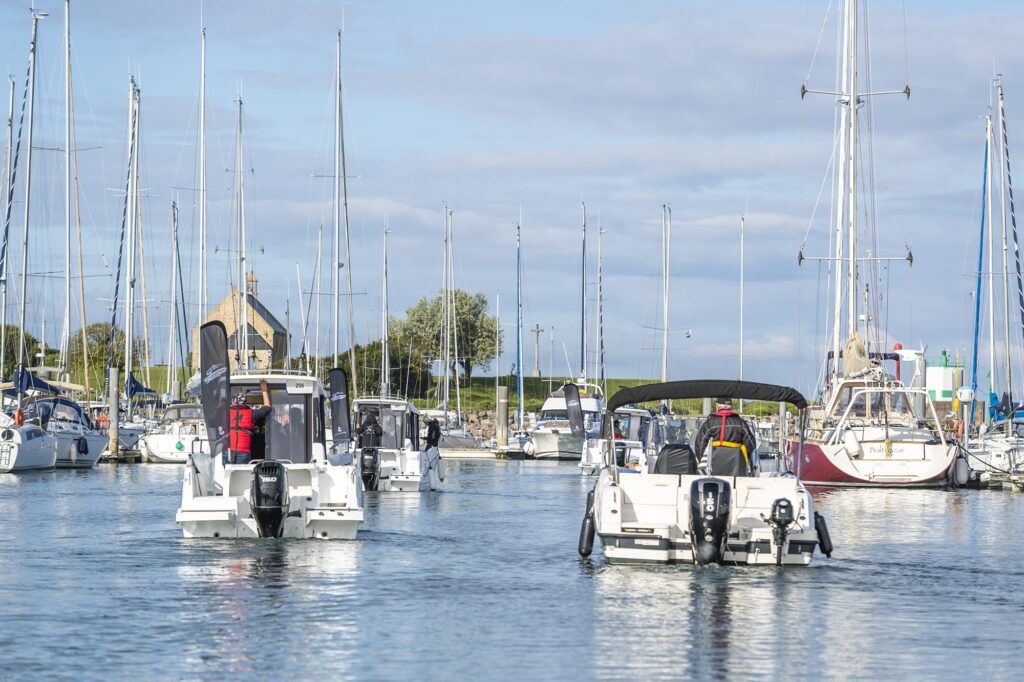
Getting underway from a crowded marina is one of the most demanding tests of boat handling. Every boat responds differently at low speeds, so understanding how yours behaves around docks, current, and wind is the foundation of good seamanship.
2. Propellers, Rudders, and the Mysterious “Prop Walk”
Most powerboats use right-handed propellers that spin clockwise when in Forward gear. Besides pushing the boat ahead, this spin creates a sideways pull on the stern called prop walk. In Forward, the stern usually drifts to starboard; in Reverse, it walks to port.
Skilled operators learn to anticipate and even use prop walk. Instead of fighting it, you can turn it into an ally when maneuvering into slips or performing a standing turn.
3. Three-Point Turns and Standing Spins
Imagine you’ve reached the end of a narrow fairway. A normal U-turn would take too much space. Enter the three-point turn, a dance of short bursts of forward and reverse that leverages prop walk and prop wash to swing the boat 180 degrees almost in place.
This is where practice pays off – each boat has its own quirks. Trying maneuvers in open water before attempting them in tight marinas will give you confidence.
4. Windage: Why Powerboats Drift Faster Than You Think
Many new powerboaters assume the wind is only a sailor’s concern. Not so. With tall freeboards, canopies, and minimal underwater keel area, powerboats can be pushed dramatically sideways by even a modest breeze.
Try shutting down your engine on a breezy day and watch how your boat drifts. You’ll be surprised how quickly the wind takes control. Knowing how your boat behaves in wind is essential before attempting close-quarters maneuvers.
5. Docking with Confidence
Docking is where everything comes together. The golden rule? “Always approach the dock at the speed you want to hit it.”
- Approach into the wind when possible – it helps slow you down.
- With a right-handed prop, favor docking to port so reverse prop walk works in your favor.
- Use a 30–40 degree approach, then shift into Reverse to stop forward motion while nudging the stern inward.
Twin-engine boats add flexibility: put one engine in Forward and the other in Reverse to “twist” the boat neatly alongside.
6. Backing into a Slip: Easier Said Than Done
Backing down is one of the most humbling skills for powerboaters. Twin-engine setups make it more manageable, especially if you face aft at the helm and use each engine as a steering lever.
For single-engine fixed-prop boats, things get trickier. Prop walk dominates, and the rudder has little effect at slow speeds. The key is balancing short bursts of throttle with rudder angle until you discover your boat’s tendencies.
Bow thrusters and spring lines can be game changers here, helping you fight wind and maintain control in tight slips.
7. Stopping Safely – From Displacement to Planing Speeds
Stopping a powerboat isn’t as simple as pulling back the throttle.
- Displacement hulls: ease back, shift to neutral, then reverse, adding a slight 45-degree turn to avoid your own stern wave flooding the cockpit.
- Planing hulls: drop throttle quickly to Neutral, let the boat settle off plane, then Reverse to stop. In emergencies (like man overboard), resist the urge to slam straight from Forward to Reverse – you risk damaging the transmission.
8. Finding Your Boat’s “Sweet Spot” for Cruising
Fuel economy and comfort depend on discovering your cruising speed – usually around two-thirds throttle. At this setting, vibration and noise drop while speed remains steady.
Planing boats have a similar “sweet spot.” Bring the boat onto plane, then reduce throttle until speed and rpm balance comfortably. Trim tabs or drive angle adjustments can fine-tune performance.
The right cruising speed isn’t just efficient – it’s the speed where the boat feels most at home.
Bringing It All Together
Maneuvering a powerboat is equal parts knowledge, practice, and confidence. From mastering prop walk to understanding windage, from backing into slips to finding your cruising sweet spot, every skill you build makes time on the water safer and more enjoyable.
If you’re ready to take your boat handling to the next level, American Boating offers hands-on powerboating courses and comprehensive textbooks designed to turn theory into real-world skill. Whether you’re brand new to the helm or looking to sharpen your advanced maneuvers, we’ll help you get there with confidence.
From the American Boating Curriculum
This article is adapted from Advanced Powerboating, the official textbook for the American Boating AB103 and AB104 certification courses.